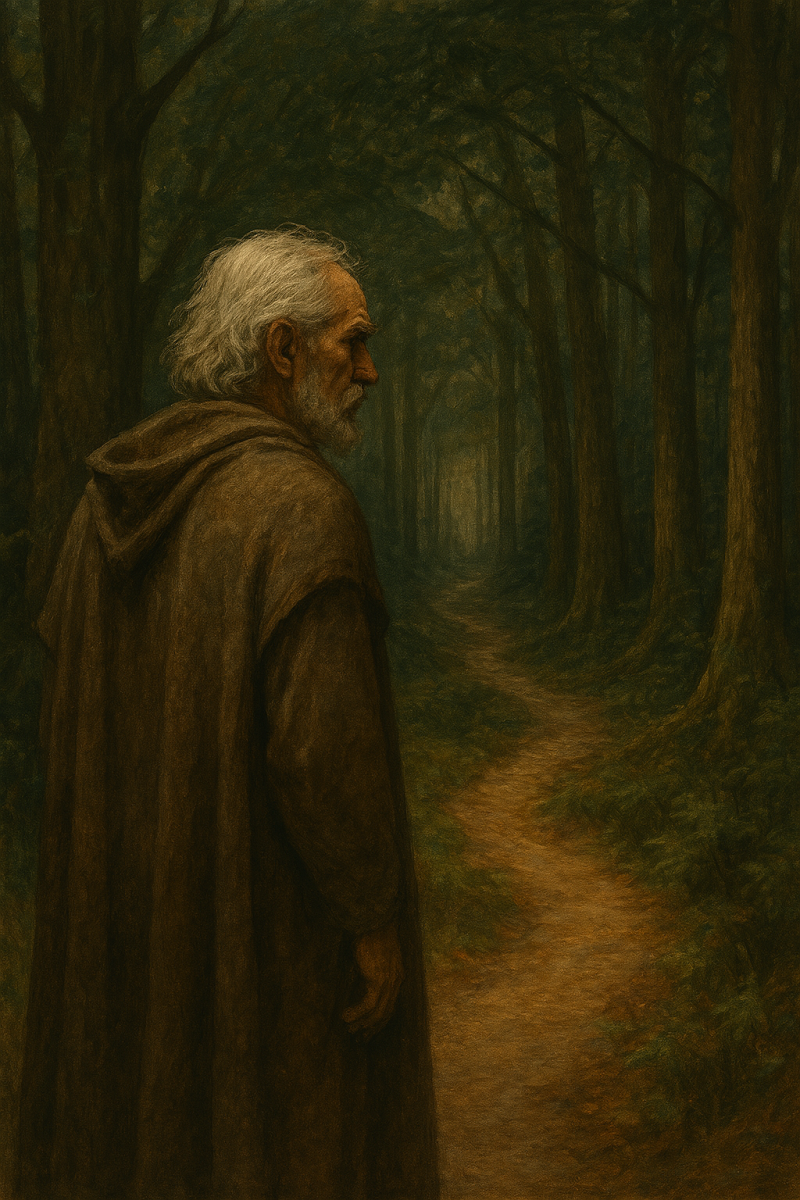
THE PLAIN OF JUDGEMENT
Adam was struggling to recall precisely why he was standing here in front of this old thatched cottage. He also wondered if he had been here before, because it felt so familiar to him; his short-term memory these days was so unreliable. Of course, he silently acknowledged to himself that his long-term memory was no better; after all, he had no recollection of his early childhood whatsoever.
Whilst he was unsure of his ability to recall places and people, he was very sure about his character. Adam was an altruist, always putting everyone else’s needs before his own. When he gave a beggar money, knowing he couldn’t afford next month’s rent, he didn’t give his actions a second thought, even though he knew the consequences. He just accepted that this was the way he was, and the man sitting on the pavement with a cap by his feet had a greater need than he of that banknote. He often wondered why he was like this; not through a sense of pride in his altruism, but through curiosity. When he examined the motivations of others, he observed their selfishness, greed, or thoughtlessness, but he did not judge them on their actions. He just assumed that individual behaviour was innate and predetermined, rather than a choice. Some people were lions, and others were prey; some were participants and others were observers; some looked only inside themselves, and others chose not to look at all. He concluded long ago that any concept of good and evil was therefore illogical, for this predisposed free will, and if he had little or none regarding his own actions, then why should others have any such freedom?
One could observe his remembered life and be amazed at its mundanity. Hospital porter, shop assistant, labourer, taxi driver, teacher. This was not a life of glamour, of power, of drama, but one of ordinariness. But as well as this, there was something else that perhaps was not so ordinary, so mundane. There was a sense of melancholy that seemed to cloak him, a feeling of ‘not quite rightness’, and it hung heavy on his shoulders.
Adam looked at the cottage door again. How peculiar that he should recall this of all things! He remembered a recent dream he’d had of this place whilst lying in a hospital bed, laid low by pneumonia, even recognising the green door with a dull brass knocker, shaped like a frog sitting on a lily pad. The dream had been strange. An old man sitting in a rocking chair, with a log fire burning in the hearth. The man’s legs were covered by a blanket, which draped around him, even covering his feet. There was a smell of peat and smoke and age (strange to think he could dream of such specific odours). The old man had a mane of golden hair, streaked with white, and a beard that grew down almost to his chest.
He knocked on the door. No answer. He turned the doorknob and entered. It was just as he had seen in his dreams. An old man, the fire, the smell.
“Who are you?” Adam asked.
“Simon,” replied the old man. “Although in another place you may know my name differently.”
“I am sorry, I don’t understand you,” said Adam. “Would you like me to sit down?”
“If you wish.”
The old man’s voice was full of calm, the accent rich with the pleasing lilt of the Irish.
He sat down. The old man continued to address him.
“Adam, you must take the road that leads west from here, towards the sea. Follow the path that leads into the woods.”
“And then?”
“And then you will discover why you must travel there. You should leave now.”
The old man emphasised the word now, twisting the vowels the way the Irish do.
“And if I choose not to follow your instruction?”
“Your nature dictates it, Adam.”
“Then I will go, even though I do not understand why I am compelled to do so.”
Adam turned to leave, the conversation at an end.
“I will see you again soon, Adam,” the man called out as he left the house.
The walk along the road from the village to the woods was long and uneventful. After an hour, perhaps two, of walking (time seemed to evade him), he arrived at the dirt path. A sign was standing by the side of the road. Red letters on a white metal plaque, held by two wooden posts.
The name on the sign read ‘The Plain of Judgement.’
He wanted to say the words out loud, but resisted the urge.
He stood still for a few minutes, as if waiting for permission to move. Something felt wrong. Then, as if receiving an unseen prompt, he continued on. The path wound its way into the woods, full of birch, elm, and larch. As he moved forward, the only sounds to be heard were the gentle whistle of the breeze through the trees, and the crunch of his boots on the leaf litter and twigs strewn across the path. He wondered where the path was leading. Soon, he lost his sense of where he was, of the direction he was taking. It was as if he was entering some sort of maze–a labyrinth, where one’s senses are bamboozled.
He stopped to study one tree. It was an apple tree, alone amongst its close relatives. Why was such a tree growing here, he thought to himself? A lone red fruit hung from one branch. He considered picking it. After a moment’s hesitation, he plucked it from the tree and took a bite. It was sweet, but the texture of the fruit was peculiar, more like eating a peach than an apple. He thought about taking another bite but decided instead to toss the apple away onto the side of the path. He pondered the strange name of the place. The name surely signified something, but each time he felt he was on the cusp of understanding its meaning, the thought melted away, like dandelion seeds in a breeze. He heard something moving in the woods. An animal? The loudness of the sound led him to believe that this was not some small rabbit or squirrel threading its way through the trees, but something larger–perhaps a deer? The sound came closer. He saw a glimpse of the thing that was making the noise. A bull? What was a bull doing in the middle of this wood? He smelt sulphur in the air.
A jolt shot through his body with such ferocity that he toppled forward, as if struck by lightning. His heart was racing as he picked himself up from the ground. He sat up, lights flashing around the corners of his eyes. He composed himself, swivelling his head left and right to shake away the shock. For a moment he thought he heard voices coming from somewhere. He shook his head again. Silence. He leaned back on his hands, breathing deeply. What had happened? Another massive jolt of pain in his chest. The taste of something akin to fresh blood in his mouth. This time he fell flat on his back. He tried to scream, but his throat was tight as a drum. As he lay stunned on the floor, an owl landed on a branch above his head. It ruffled its feathers and stared down at him, then hooted. He pulled himself up again. The owl hooted twice more, then flew off.
What was going on? He looked up and saw a man standing in front of him. The man was dressed in red robes; his long copper-coloured hair and beard partly obscured his face. He carried a staff, held in his left hand. A few drops of rain fell. Adam liked the smell of rain, but this smelt of something else. What was it? The smell of sulphur still?
“Do I know you?” said Adam.
He looked more closely at the man in front of him. It was Simon, the occupant of the cottage! Then he gasped in astonishment. A tail, scaly and sinuous, wound its way around Simon’s feet like a snake. The coils undulated slowly, loosening and tightening around the red linen of his robes.
“Do you know why I am here, Adam?”
Adam shook his head.
“Do you remember my name?”
“It is Simon.”
“Here it is not. Here you will call me by my real name, which is Minos. I exist here with the Minotaur, whose breath you recently felt upon your face, my brother Rhadamanthus, and Aeacus.”
“But why am I here in this place?”
“It is to be judged, Adam.”
“Judged? Why are you judging me? How will I be judged?”
“You are to be judged on the actions of your life. Those you remember and those you have chosen to forget.”
“Chosen to forget?”
“Yes. I can help you remember if you wish.”
“Do I have a choice?”
“Yes, you always have a choice. Free will exists, even though you think it doesn’t.”
“And does my answer influence your judgement?”
“No.”
“Then I choose to remember.”
It came back to him in a rush, a cascade, a torrent, a flood.
He is a child once more. He can feel heat all around him. He can’t see anything clearly because the air is thick with smoke. Flames begin to lick around him like red lightning. His eyes are burning, and his throat burns, and his mouth burns. He remembers now. It is nighttime. He is playing with matches in his bedroom, even though he was forbidden to do so by his father, and now the fire he has created seeks to escape. He tries to stop the fire, but he cannot, so he gives up trying to put it out and runs blindly into a wall to get free from the smoke and the heat, and the flames. All is black. Now he sees himself lying in a bed. It is a hospital, and there are doctors and nurses around his bed. Where are his parents? His baby sister? Are they in the hospital with him, too? Oh God, what has he done?
Judgement is passed. The tail of Minos unfurls and sways in the air. It is enormous, cruel, and magnificent. Its scales flicker with brimstone and lightning. Two figures emerge from behind Minos. They are both full-bearded, wearing knee-length chitons, belts holding their kolpos folds in place. One is much younger than the other. Their eyes are cold and black. Adam cries, but no tears fall down his cheeks. He is dying now, his fluid-filled lungs deflating as a last breath slips from his mouth. A death rattle. Adam’s heart, so recently shocked back to life by the defibrillator, stills.
At the entrance to the Plain of Judgement, the file of silent figures shuffle forward. None can see another, and each unknowingly awaits their turn to enter. Minos, Rhadamanthus and Aeacus await to pronounce their judgement upon them.
.
Author’s note
In Greek mythology, Minos was a king of Crete, son of Zeus and Europa. Every nine years, he made King Aegeus pick seven young boys and seven young girls to be sent to Daedalus‘s creation, the labyrinth, to be eaten by the Minotaur. After his death, King Minos became a judge of the dead in the underworld. In Michelangelo‘s famous fresco, The Last Judgment, Minos is depicted as surrounded by a crowd of devils, with his tail coiled around him. Minos would judge those in front of him, and, if he found them wanting, would condemn them to damnation in hell.