WALK ON BY
Adam had no recollection of his childhood. It was as if that part of his memory had been erased, perhaps by chance, perhaps through design. His was a life a service, at least for the parts he remembered. Adam was a person who always considered others before himself, seeking neither acknowledgement nor praise. It was as if he were driven by some unknown benevolent force, some unheard voice giving direction to the way he lived his life.
Sometimes he wondered why he was like this, not through a sense of pride, but through curiosity. He saw the actions of others and recognised their occasional motivations of selfishness, greed and thoughtlessness. He did not judge others though, assuming that such behaviour was innate, predetermined, rather than by choice. Some people were lions, and some were prey; some were participants and some were observers; some looked only inside themselves and some chose not to look at all. He concluded that any concept of good and evil was illogical, for this predisposed free will, and if he had none, they why would others?
We could observe his remembered life and be amazed at both its purity of nature and its ordinariness. Hospital porter, shop assistant, labourer, taxi driver, teacher. This was not a life of glamour, of power, of drama. Yet, this ordinariness was in its own way remarkable. However, there was one thing that one could observe concerning Adam, if one had a nose for such things. There was a sense of regret that seemed to cloak him, a feeling of ‘not quite rightness’, perhaps even guilt? For good reason, as we will discover.
Now, Adam stood in front of a cottage door. He already dreamt of this place. Even the door – a green one with a dull brass knocker shaped like a frog sitting on a lily pad. The dream had been strange – of a man sitting in a rocking chair, a log fire burning in the hearth. The man’s legs were covered by a blanket, perhaps to keep him warm. A smell of peat and smoke and age permeated the room. The man had a mane of golden hair, well-streaked with white, and a beard that grew almost to his chest. The dream had first come to Adam as he slept in a hospital bed, ill with pneumonia.
Adam struggled to remember how he had arrived in front of this door. Perhaps he was still dreaming? He knocked on the door. No answer. He turned the doorknob and entered. It was just as he had imagined. An old man, the fire, the smell. The man in the rocking chair looked up as he entered.
“Who are you?” Adam asked.
“Simon,” replied the old man. “Although you may know my name differently.”
“I am sorry, I don’t understand. Would you like me to sit down?”
“If you wish.” The old man’s voice was full of calm, the accent rich with the pleasing lilt of the Irish.
He sat down. The old man continued.
“Adam, you must take the road that leads west from here, towards the sea. When you come to a place called Walk on-By, follow the path that leads into the woods.”
“And then?”
“And then you will discover why you had to go there. You should leave now.”
The old man emphasised the word now, twisting the vowels how the Irish do.
Adam thanked the man for his guidance and wished him goodbye.
“I will see you again, Adam,” the man called as Adam left the house.
The walk along the road to the woods was long and uneventful. After an hour, perhaps two, he arrived at the dirt path. A sign was standing by the side of the road. Red letters on a white metal plaque, held by two wooden posts.
Walk on-By
The letters were loud, ominous.
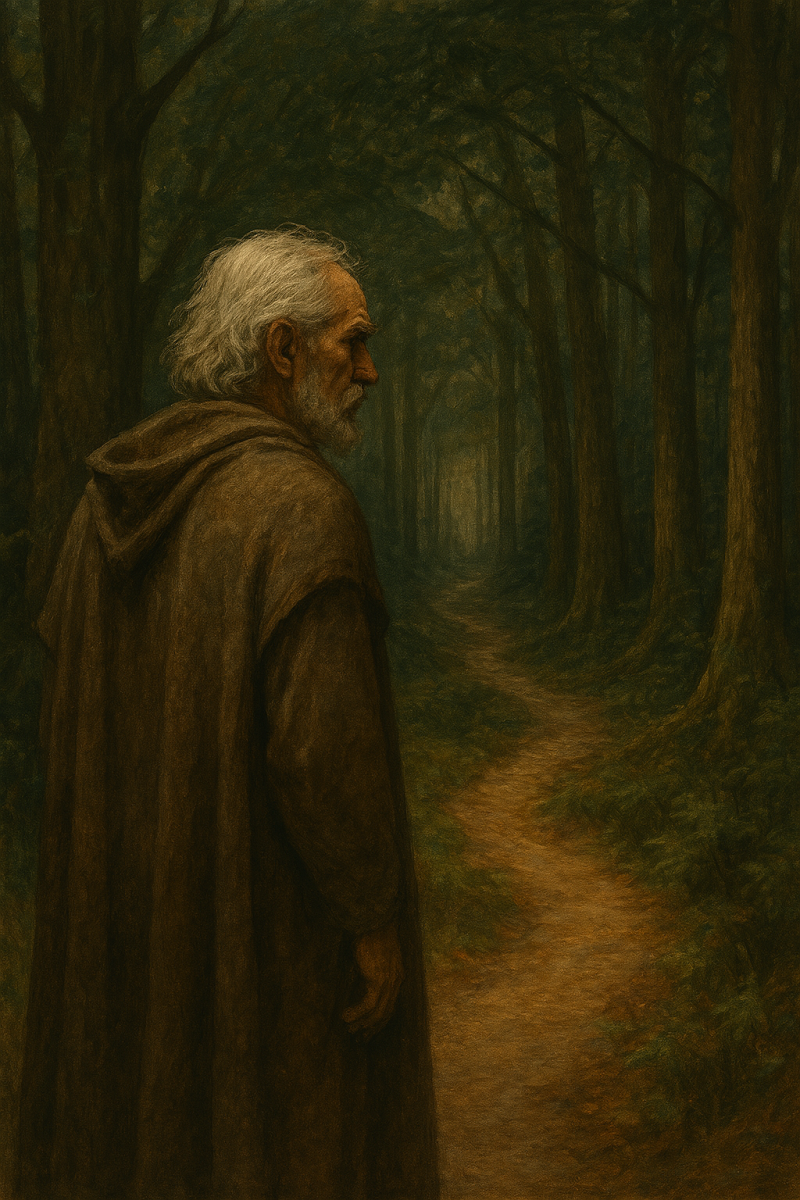
Something felt wrong to him, but he could not see any obvious reason for this to be so. The path wound its way into the woods, full of birch, elm, and larch. He did as the old man told him, despite his feeling of unease. As he moved forward, the only sounds to be heard were the gentle whistle of the breeze through the trees, and the crunch of his boots on the leaf litter and twigs strewn across the path. He wondered where the path was leading. Soon, he lost his sense of where he was, of the direction he was taking. It was as if he was entering some sort of maze – a labyrinth, where ones senses are bamboozled.
He stopped to study one tree. It was an apple tree, alone amongst its close relatives. Why was such a tree growing here, he thought to himself? A lone red apple hung from one branch. He considered picking it. After a moment, he plucked it from the tree and took a bite. It was sweet, but the texture of the fruit was peculiar, like eating a peach more than an apple. He thought about taking another bite but decided instead to toss the apple away onto the side of the path. He continued. As he did so, he pondered the strange name of this place.
Walk on-By
Perhaps this place, this name, signified something, but each time he was on the cusp of grasping its meaning, the thought melted away, like dandelion seeds in a breeze. He heard something moving in the woods. An animal? The loudness of the sound led him to believe that this was not some small rabbit or squirrel threading its way through the trees, but something larger – perhaps a deer, or even a person? His sense of unease increased as the noise seemed to get closer.
A jolt shot through his body with such ferocity that he toppled forward, as if struck by lightning. His heart was racing as he picked himself up from the ground. He sat up, lights flashing around the corners of his eyes. He composed himself, swivelling his head left and right to shake away the shock. For a moment he thought he heard voices coming from somewhere. He shook his head again. Silence. He leaned back on his hands, breathing deeply. What had happened? Then another jolt crashed through his body; this time he fell flat on his back. He tried to scream, but his throat was tight as a drum. As he lay paralysed on the floor, an owl landed on a branch above his head. It ruffled its feathers and stared at him. Gradually, his senses returned, and he pulled himself up again. The owl flew off, returning whence it had come.
Adam stood up. What was going on? He caught a movement in the corner of his eye. Standing some ten metres in front of him was a man. Perhaps this was the source of the sound he had heard? It was not, and if Adam had actually seen what lurked behind the trees, he would have fled in terror. The man was dressed in red robes, long copper-coloured hair and beard partly obscuring his face. He carried a staff, held in his left hand. A few drops of rain fell. Adam liked the smell of rain, but this rain smelt of something else. What was it? A smell of burning? He blinked and wondered if the man would disappear, but no, he was real.
“Do I know you?”
As Adam asked the question, he looked more closely at the figure before him. He recognised his own face looking back at him. Something else. He had been so intent on staring at his face he had failed to notice that the man appeared to have a tail, snaking around his feet. The coils undulated slowly, loosening and tightening around the red linen of his robes.
“Do you know why I am here, Adam?”
Adam shook his head. Was that a yes or a no? We don’t know. Let us return to witness what will happen.
“It is to judge you,” said the man in a voice both deep and sonorous.
“How will I be judged?”
“You are to be judged on the actions of your life. Those you remember and those you have chosen to forget.”
“Chosen to forget?”
“Yes. I can help you remember if you wish.”
“Do I have a choice?”
“Yes, you always have a choice.”
“And does my answer influence your judgement?”
“No.”
“Then I choose to remember.”
It came back to him in a rush, a cascade, a torrent, a flood.
He killed his parents. He wished to forget again, but it was too late.
The judgement is passed. The tail unfurls and sways in the air. It is enormous, cruel, magnificent. Adam cries, but no tears fall because he is dead, his fluid-filled lungs deflating as his last sibilant breath slips out from his mouth. Adam’s heart, so recently shocked back to life by the defibrillator, finally stills.
At the entrance to Walk on-By, a queue of figures stretches into the distance. None can see another, and each waits their turn to enter the woods. Minos awaits each one, his judgement terrible and final.
Author’s note
In Greek mythology, Minos was a king of Crete, son of Zeus and Europa. Every nine years, he made King Aegeus pick seven young boys and seven young girls to be sent to Daedalus‘s creation, the labyrinth, to be eaten by the Minotaur. After his death, King Minos became a judge of the dead in the underworld. In Michelangelo‘s famous fresco, The Last Judgment, Minos is depicted as surrounded by a crowd of devils, with his tail coiled around him. Minos would judge those in front of him, and, if he found them wanting, would condemn them to damnation in hell.