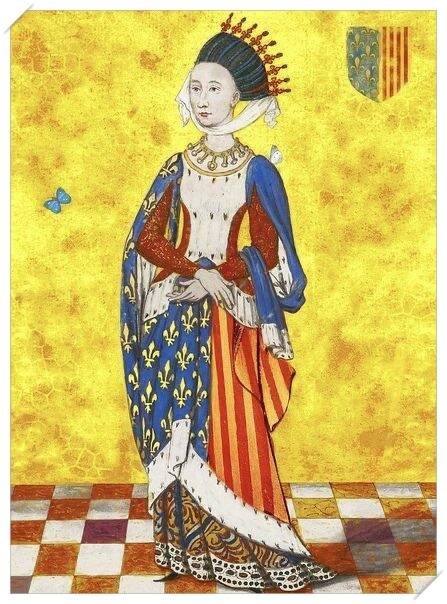
Lights rise slowly. Enter Jean De Halliday, our troubadour of time
JEAN DE HALLIDAY Welcome back my friends, to the show that never ends. We’re so glad you could attend, step inside, step inside!
After the passing of Eleanor in the year of our lord 1204, we behold France entering a new century— a time of counts, crusades, and above all, Capetians. The dynasty has grown strong and its realm, once fragile, now stretches across the heart of the continent of Europe. From Flanders to the Pyrenees, from the Atlantic sea to the Rhine, France is becoming a mighty kingdom to be both envied and feared. Life for people like me though — farmers, merchants, craftsmen, troubadours — is still a sour mix of hardship and hope. Fields are tilled by hand, harvests prayed are for, and winters feared. And yet towns are swelling, trade is stirring, and troops are gathering. France is flexing its adolescent muscles.
In Europe’s heart, now hear my refrain, the Capet kings are set fair to reign.
Their banners rise where feudal borders lay, and their realm grows stronger, day by day.
In Paris, Tours, Rouen and Reims, the people flock, in search of their dreams.
Yet nobles scheme, and bishops pray, while peasants just live from day to day.
And far to the south, in Provence, the true troubadour spirit endures — where sons may learn to wield their weapons for God or their Lords, but daughters who wish to prosper must learn to fight with wit, charm, and cunning.
In that world, in the spring of 1221, a child is born, who will one day stand beside a saint, defy a queen, and hold a kingdom together while her husband is bound in chains. Her name is Margaret of Provence. Come with me now, as we leap forward in time- thirteen years in all, to the cathedral of Sens, in Bergundy, where Margaret, still a child, is to be married on the morrow to Louis IX, King of France.
Lights dim. Jean De Halliday steps back into the dark.
ACT I “THE QUEEN TO-BE”
Lights raise. three figures inhabit the stage- Margaret, Blanche and Louis.
JEAN DE HALLIDAY We find ourselves in a chamber in the beautiful Cathedral of Sens, in Bergundy. The young Margaret regards the king. Louis has reached the age of twenty, and she studies his youthful features. So this is the man she will spend the rest of her life with? Next to Louis stands his mother, Blanche-a slender woman dressed in a deep blue silk gown, its sleeves long and narrow. A white wimple frames her head, the veil falling in soft folds around her face. Her mantle — crimson with a fur lining — is clasped at the breast with a square sapphire brooch. Her expression is serene but unyielding: a woman who expects obedience but gives none lightly.
MARGARET. I would have preferred that my attendants would accompany me, madame ma dame.
BLANCHE I asked that your Provençal women be removed from our presence. France has no need of foreign tongues whispering in its halls.
MARGARET (annoyed, then composed) But they are my household, madame. They have served me since birth. I would ask that they be allowed to remain with me.
BLANCHE No. Now you will serve France and you are under my care. Your place is here —but under my guidance alone. They will leave this place completely by nightfall. You have no need of them now.
LOUIS Mother… perhaps Margaret would feel more...at ease….should she be allowed to retain some of her attendants?
BLANCHE (interrupting) Louis. A king must not be ruled by sentiment. Your bride will adapt.
Louis falls silent. Margaret bows
MARGARET As France requires, I will obey you in all things. But my obedience is not the same as my loyalty. For me, loyalty must be earned.
Blanche studies her — surprised by the spark.
BLANCHE You are impertinent girl. You are very soon to be Queen of France. Now, before that crown touches your head, I would hear once more, but from your own lips this time, concerning your lineage.
MARGARET (steady, respectful) Madame, you know my family well. My father is Ramon Berenguer, Count of Provence. My mother, Beatrice of Savoy.
BLANCHE I know your parentage. I know the alliances with your house. And I also know of their debts. (leans back) What I wish to know is whether you understand as well?
Margaret inhales — a small, controlled breath.
MARGARET Madame… my house is not as mighty as some in its wealth, but it is mighty in spirit and in godliness. We descend from the old counts of Barcelona, where law and learning have flourished for generations. My mother’s kin have served emperors with honour, and my sisters— (chooses her words carefully) —my sisters now sit on thrones where they have proven themselves worthy.
Blanche’s eyes sharpen. Of course, she already knows all of this; she is listening for tone, for arrogance, for weakness in the girl.
BLANCHE Worthy- an interesting choice of word. And you will seek to be the same?
MARGARET (quiet, firm) I speak as I believe, Madame ma dame.
Blanche studies her — not displeased, but not yielding either.
BLANCHE Your mother’s brothers are ambitious men. And yet I hear that your father’s court is full of poets and flatterers. Some would say that may breed vanity to those within.
MARGARET (holds Blanche’s gaze) And some would say it breeds refinement, Madame ma dame. As well as grace and learning.
Blanche’s expression does not soften, but something shifts — a flicker of respect, or perhaps recognition of the resolve of this girl that stands before her.
BLANCHE Very well. I wished to see whether you would boast, or shrink, or pretend ignorance. You did none. (stands) France is not Provence, and do not forget this fact. The crown you will wear will be heavier than you imagine.
Margaret bows — not meekly, but with controlled dignity.
MARGARET I will bear it, Madame. With honour.
Blanche exits. Louis approaches Margaret.
LOUIS Forgive my mother’s tongue, Margaret. She merely seeks to protect me, and the crown I wear.
MARGARET And will you protect me, King Louis?
Louis smiles. Margaret bows and turns away..
JEAN DE HALLIDAY She came to France with hopeful heart and vow, Yet Blanche’s gaze weighs heavy on her now.
Blanche’s smile is thin, her questions sharp, she plays on emotions like a high-strung harp.
Margaret speaks with grace, fear stirs in her breast — For queens may bow, but daughters must be blessed.
If mother is flint, then daughter must answer flame, And prove her spirit worthy of her name.
Still, in Blanche’s eyes I sense a storm to come — A mother fierce, a rival to her son.
Blackout.
ACT II - “DAMIETTA”
Soft light. Jean De Halliday steps forward.
JEAN DE HALLIDAY Many courts and kingdoms across Europe were in these years ruled by women in the shadows. Blanche of Castile is one such woman, for she is the real power behind the French throne, guiding her son through rebellions, famines, and the politics of a realm still learning to accept a single crown.
Across France, the nobility simmers The south has been reminded of its long lost freedoms, whilst the north bristles with frustration under the orders of royal officials. Young King Louis — earnest, devout, untested — instead seeks holiness in a world that surely demands strength as well as piety.
In the meanwhile, Margaret struggles to finds her place. A young queen with little real power, a wife whose influence is overshadowed by her mother-in-law. She is a foreigner in a court that watches her every breath.
But history has a habit of testing the overlooked. Margaret’s first trial will come not from within the borders of France, but on the sands of Egypt.
It is the year 1250. and we are in the Governor’s hall in Damietta, Egypt— the smell of the Nile’s breath thick in the air, and the banners of France hanging heavy with dust and uncertainty. Margaret knows it not yet, but the King has been taken captive, and his army is almost broken. In this fragile stronghold Margaret of Provence must stand firm against the infidel. To understand the woman who holds this city together, we must look back across the years that brought her here.
When she first entered France as Louis’s bride, she was young and untested—a princess raised on learning and courtliness, not power. Her mother-in-law, Blanche of Castile kept a tight grip on her. Louis, devout and distant, offered reverence more than love.
But she soon learned to endure slights without flinching, to navigate factions without faltering, to carry the dignity of a queen even when others sought to diminish it. She bore heirs to Louis, whilst mastering the discipline of survival at the centre of a kingdom’s court.
And in 1250 when Louis turned toward the East, to lead a crusade once more towards the Holy Land, she did not remain behind. She crossed the sea with him. She knew that she might be called upon to be a leader who could negotiate with enemies, rally soldiers, and protect a city, even whilst carrying a child.
This is the woman who stands before us now. Not the bride some underestimated, but the ruler who refuses to let the kingdom fall. The heat is oppressive in the hall. Outside, the muffled sounds of a strained garrison drift through the open shutters. Margaret stands at a long table strewn with maps, and Captain Raoul De Ferrieres, her senior commander, stands beside her. A messenger, dust covered and barely upright, is brought in by guards. Let us listen to what he has to say.
Lights fade, then return. We now see a dim chamber lit by oil lamps. Outside, distant shouting. Margaret, heavily pregnant, grips a table
MARGARET Speak to me. What news do you bring?
MESSENGER (hoarse, trembling) Majesty… the king… he has been taken.
Raoul stiffens. Margaret does not move.
MARGARET Where?
MESSENGER In Mansourah, Madame. After the retreat failed. The Mamluks seized him, together with the nobles who remained at his side. We believe that they hold him in a merchant’s house near the river. Our spies say that the infidels argue over his fate.
RAOUL Argue? Over a king?
MESSENGER Some want ransom. Others… believe a dead king sends a clearer message.
Margaret frowns, but her voice remains level.
MARGARET What news of the army? How many of our men survived?
MESSENGER Too few, Majesty. Fever and the fighting have thinned the ranks.
MARGARET (turning to Raoul) And here? How do we fare here?
RAOUL (grim) The walls stand firm , but the men upon them— (he hesitates) —Majesty, they are exhausted. The southern tower is undermanned. The harbour holds only five ships fit to sail. Supplies… perhaps a fortnight, if rationed.
MARGARET You tell me then, commander, that we cannot withstand a siege of any length?
MESSENGER The enemy scouts are already near the outer dunes. They watch the gates. They know the king is taken. They know we are weak.
Margaret steps closer to the messenger, her expression unreadable.
MARGARET Look to me. (He forces himself to meet her eyes.) Did the king send any word to me before he as captured?
MESSENGER None your majesty.
Raoul exhales sharply. Margaret nods once, absorbing the weight of it.
MARGARET We will not yield. We hold this city until the King is safely returned.
RAOUL Majesty, we should arrange for your immediate return to France. Damietta is a not safe place for you or for the child of the King that you carry. If the Mamluks strike now—
MARGARET (cutting him off, calm but absolute) If Damietta falls, Louis dies. If Damietta holds, they must bargain. (She turns to the messenger.) You will write a full account of all you know, every detail you remember. Nothing omitted.
MESSENGER Yes, Majesty.
He leaves the room. Raoul waits until the door closes.
RAOUL Majesty, what are your orders?
MARGARET We hold. We double the watches. We ration supplies. (She meets his gaze, steady as iron.) Damietta will not fall while I draw breath. And I will have my King back.
Raoul bows his head
RAOUL Then we will hold, Majesty.
Lights fade as the distant sound of drums begins to rise outside the walls. Blackout. A single spotlight on Jean De Halliday
JEAN DE HALLIDAY
When Louis fell into his enemies clutches, the Mamluks named their price.
Gold, not glory, bought him back—France paid the king’s release.
The crusade faltered the day he fell; its fire was quenched in sand,
The army that marched from Europe’s shores limped home - a broken band.
Yet Margaret held Damietta firm while fear consumed the rest
She ruled from within its walls and proved herself the best.
Blackout
ACT III — “THE WIDOW’S RECKONING”
Jean De Halliday steps into a pool of cool blue light
JEAN DE HALLIDAY When Louis and Margaret returned to France, they carried the memories of Egypt with them. The crusade failed, its glory spent, and its shadow stretching across the years that followed. Louis turned inward, more devout than ever, seeking in prayer what he had lost in battle. He rebuilt churches, reformed laws, and ruled with a piety that left little room for the woman who had saved his crown. Margaret, once the defender of Damietta, found herself pushed again to the margins—respected, but rarely heeded. Yet she did not forget the siege, nor the strength she had discovered within it. She raised their children. She guarded the realm when Louis travelled, steadied it when factions stirred, and kept the memory of her own command alive in the quiet authority she carried through the court. But the years wore on, and Louis’s gaze turned eastward once more. In 1270, he sailed again—older, weaker, and driven by a faith that no counsel could soften. Margaret remained behind, ruling in his absence as she had once ruled in Damietta. The siege had forged her. The years had tempered her. And history would remember her not for the crown she wore, but for the strength she had carried when all else had fallen. Let us go now to Paris in 1271, where news of her husband awaits.
It is late afternoon. The light is thin, winter pale. Margaret sits at a writing table, documents neatly arranged. A fire burns low. Outside, the muffled sounds of the palace drift like distant waves. A knock. Her steward, Jean De Joinville, enters—solemn, carrying the weight of a message he does not wish to deliver. The lights dim. We are in a room in her private quarters. Margaret hears a knock at the door.
lights dim. Lights return to the stage and we see three figures
JOINVILLE Your Majesty… forgive the intrusion.
MARGARET (without looking up) You would not disturb me at this hour unless the matter pressed. Speak.
Joinville hesitates. She senses it immediately and lifts her gaze, sharp and steady.
MARGARET What has happened?
JOINVILLE A rider has come from the coast. From Tunis.
Margaret’s hands still, but she does not flinch.
MARGARET The King? What news? And my son? Is Philip safe? ?
JOINVILLE Philip lives. He commands the host now.
Margaret nods once.
MARGARET Then it is the King.
Joinville bows his head.
JOINVILLE The king died of the fever. He spoke your name before the end.
Silence. Margaret closes her eyes
MARGARET How long ago?
JOINVILLE Six days, Majesty. They tended him as best they could.
MARGARET And what of the army?
JOINVILLE Disordered, but not broken. Prince Philip has taken command. They will return as soon as the sea allows.
Margaret rises slowly. She walks to the window, looking out over Paris—the city she once ruled in his absence, the city she steadied after Damietta, the city that never fully understood her strength.
MARGARET I sensed this crusade would take him. He was never more alive than when he chased death in God’s name.
JOINVILLE Majesty, I await your instruction.
MARGARET (She turns back to him.) Send word to the council. France must not falter. And prepare my household—I will go to meet my son when he returns to France.
JOINVILLE At once.
He bows and exits. Margaret stands alone in the fading light.
MARGARET (quietly, to herself) I held a city when all was lost. I can hold a kingdom now.
The fire burns low. The lights dim The narrator steps forward into a single, steady light.
JEAN DE HALLIDAY Margaret died but five short years before the end of the century, her courage writ large into the pages of royal chronicles. Soon, a girl will be born in Venice — a girl who will come to Paris, who will take up a pen instead of a crown, and who will search the past for women like Margaret. Her name is Christine de Pizan, and she will build a veritable City of Ladies from ink alone, and inside its walls she will place queens, warriors, scholars — all women of greatness, fame and glory.
blackout
END